How to Prepare Your Motorcycle for a Road Trip: The Complete 15-Point Checklist
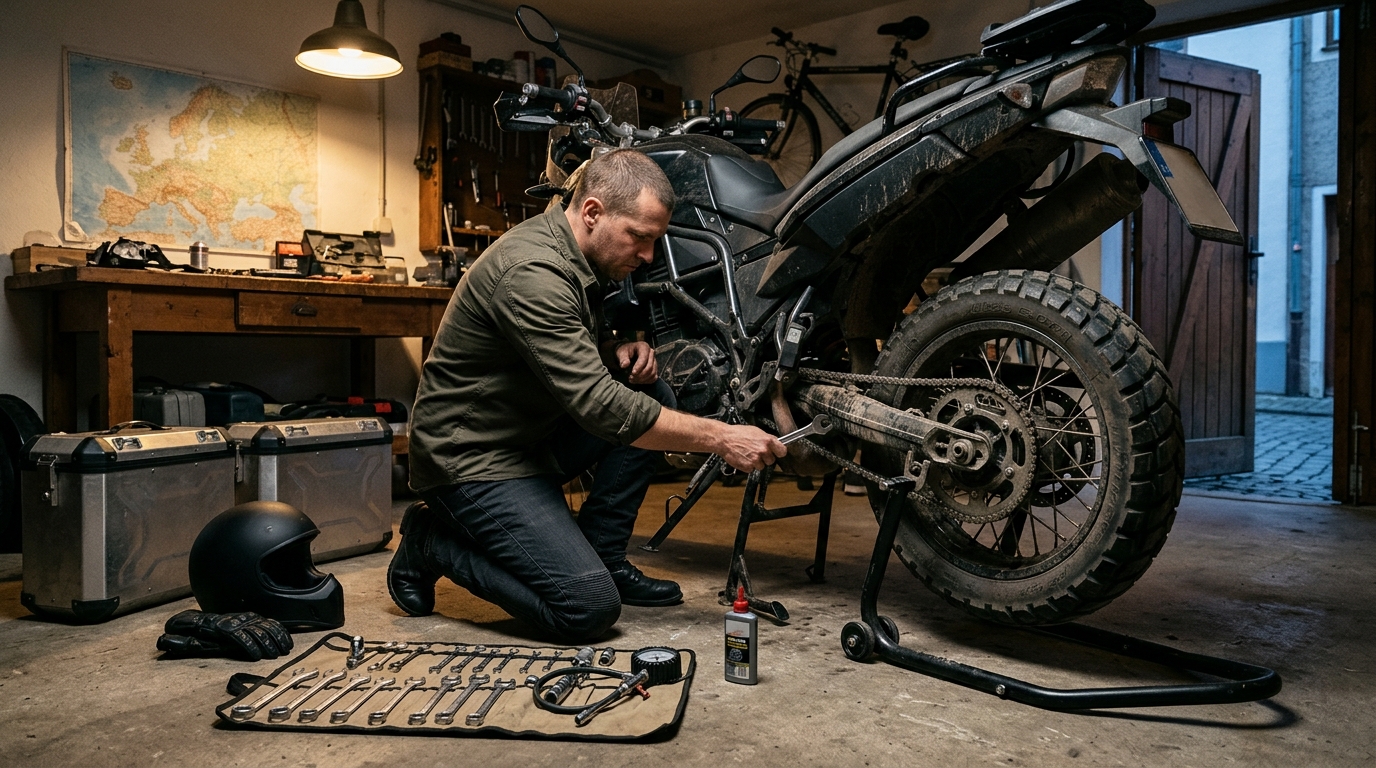
A preventable mechanical failure halfway up an Alpine pass turns a dream holiday into an expensive weekend recovery truck ordeal. Veteran tourers live by one golden rule: complete your pre-trip inspection 7 to 10 days before departure — never the night before you leave. That buffer gives you time to source replacement parts and log a proper shakedown ride.
Tires, Brakes & Chassis Setup for Mountain Switchbacks (Points 1–5)
Coarse, high-grip mountain asphalt in the Alps, Dolomites, or Pyrenees scrubs rubber nearly twice as fast as flat commuter roads, while steep 20-kilometer descents with full luggage put tremendous thermal stress on your brakes:
- Tire tread depth & profile (min. 3.5–4.0 mm): Inspect more than just TWI wear bars — a squared-off highway center or cupped front shoulder makes the bike resist leaning smoothly into tight hairpins.
- Cold tire pressures set for full load: Inflate to your manufacturer’s two-up / pannier spec (typically 2.5 bar / 36 psi front and 2.9 bar / 42 psi rear) and inspect valve stems and TPMS sensors.
- Front & rear brake pad thickness: Riders use the rear brake constantly to stabilize tight low-speed hairpins and control downhill speed; replace any pad set below 50% friction material before leaving home.
- Fresh DOT 4 / DOT 5.1 brake fluid: Brake fluid absorbs moisture over time. Fluid older than 18–24 months can boil on long descents like Stelvio or Sella Ronda, causing sudden lever fade when you need stopping power most.
- Steering head bearings, wheel bearings & fork seals: Lift the front wheel to check for center-detent notchiness in the steering stem, spin wheels to listen for dry bearings, and check stanchions for weeping fork oil.
Drivetrain, Fluids & Suspension Preload (Points 6–10)
Strapping 35–50 kg of panniers and camping gear onto the tail alters chassis geometry, compresses rear travel, and makes the engine work harder up steep climbs:
- Chain slack under load, sprockets & chain slider: Always verify chain slack with full luggage loaded — an overly tight chain stresses the countershaft bearing over bumps. Check for hooked sprocket teeth and stiff O/X-ring links (or inspect final-drive oil on shaft-driven bikes).
- Fresh engine oil & oil filter: If your next scheduled oil change falls anywhere within your planned tour mileage plus a 1,000 km safety margin, change oil and filter before rolling out.
- Cooling system & radiator protection: Verify coolant level in the expansion tank, inspect hose clamps for seepage, clear bug debris from radiator fins, and confirm the cooling fan cycles on properly.
- Rear spring preload & rebound damping: Wind up rear preload and add rebound damping clicks for luggage weight so the bike maintains cornering clearance on hairpins and keeps the low-beam headlight aimed at the road, not oncoming eyes.
- Clutch & throttle cables (or hydraulic clutch fluid): Check lever free play, inspect cable strands near the perch for fraying, and ensure crisp throttle snap-back from full left to full right steering lock.
Electrical System, Navigation Cockpit & SOS Repair Kit (Points 11–15)
Modern motorcycle touring relies on weatherproof cockpit power and self-sufficiency when a stray screw punctures your rear tire miles from the nearest town:
- Battery health & charging voltage under load: Hold 3,000 RPM with headlights, heated grips, and phone charger active — a healthy regulator/rectifier should deliver 13.8–14.4 V across the battery terminals.
- Weatherproof USB-C / 12V socket & vibration-damped phone mount: Use an anti-vibration mount module to protect smartphone camera optical image stabilization (OIS), and pack a spare waterproof charging cable.
- Pannier racks, latches & low center-of-gravity packing: Torque subframe rack bolts (using medium-strength blue threadlocker) and pack heavy tools low and evenly split between side panniers — keep the top box light.
- Tubeless tire plug kit + cordless mini-compressor: Sticky butyl repair strips, reamer/insertion tools, and a pocket electric inflator turn a tour-ending puncture into a 15-minute roadside coffee break.
- DIN 13167 first-aid kit, fuses & spare transponder key: Carry blade fuses, heavy-duty zip-ties, gaffer tape, travel chain lube, a DIN 13167 first-aid pouch, and a spare immobilizer key stored in your riding buddy’s jacket or an inner pocket.
Run a 48-Hour Loaded Shakedown Ride
Two days before departure, mount all packed panniers and ride a 40 km loop of twisty local backroads. You will immediately spot handlebar deceleration shimmy between 60 and 80 km/h, glare or obstructed dash indicators behind your phone mount, or soft rear damping — letting you dial everything in calmly in your own garage before day one.